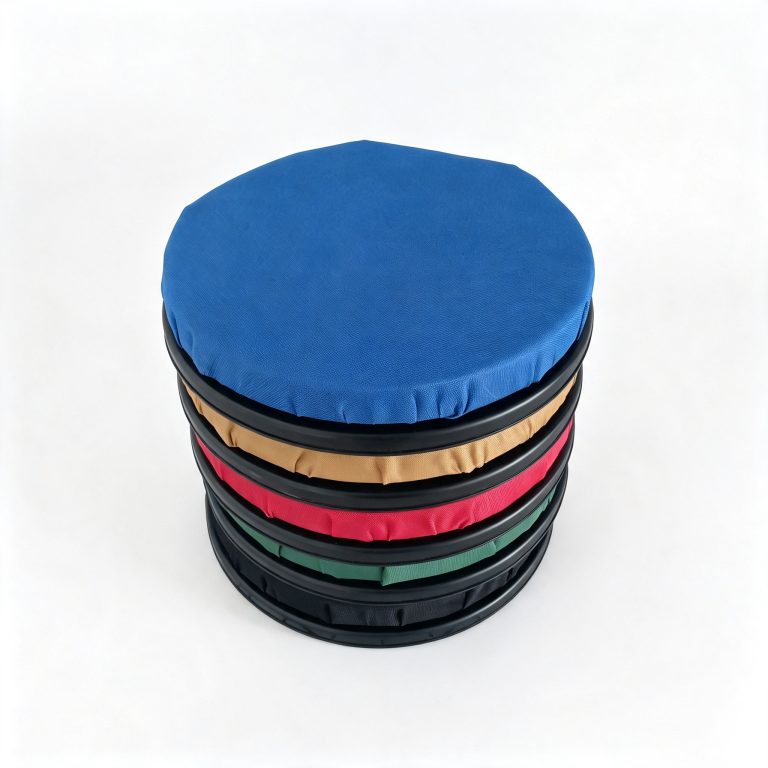
A 25L sample can pass a manual fill trial and still fail on the production line. The lid may need more press force than the closing station can provide, a wider top diameter may interfere with guides, or a warm sauce may soften the sidewall before the bucket reaches the pallet. Capacity alone does not settle any of these issues. A bulk food bucket has to match the product, filler, closure process and distribution load as one packaging system.
Quick answer
For bulk food ingredients, choose a 20L or 25L polypropylene bucket only after matching its actual dimensions, working fill volume, filled mass, lid system and pallet pattern to the production line. Rulyda’s current catalog lists round and square PP models in both capacities, but nominal liters do not confirm hot-fill suitability or safe stacking. Buyers should run line trials with the real product, record closure force and leakage results, and validate compression after filling and cooling. Food-contact documentation must cover the finished article and intended conditions of use, not merely identify the base resin.
The purchase specification starts with the food, not the bucket volume
“20L bucket” describes nominal container capacity. It does not state how much product should be filled, how much headspace is needed, or whether the filled pack can be stacked immediately after closing.
Before requesting samples, give the supplier a product profile:
- product type: sauce, syrup, dairy ingredient, oil, paste, powder or granule;
- density at filling temperature;
- fill temperature and time at elevated temperature;
- target net mass and required headspace;
- acidity, fat content and any aggressive flavor or color components;
- expected cooling method and time before palletizing;
- distribution temperature, pallet height and storage duration;
- opening, resealing and tamper-evidence requirements.
The first mass check is simple:
Filled product mass (kg) = working fill volume (L) × product density (kg/L)
This is a planning calculation, not a bucket load rating. A dense paste can make a 20L pack heavier than a 25L pack filled with a lower-density ingredient. Add the bucket, lid and handle mass when checking conveyors, manual handling and pallet load.
Current Rulyda 20L and 25L PP bucket options
Rulyda’s plastic bucket catalog lists round and square injection-molded PP formats. The values below reproduce the current catalog entries; they are not recommended fill weights or stack ratings.
The catalog dimensions are useful for a first line-layout review. Buyers should still request controlled drawings for the selected bucket and matched lid. Top dimensions alone do not define the rim profile, lid engagement or denesting clearance.
There is also a content discrepancy to resolve before purchase: the current 25L square bucket page identifies a 25L product in its H1, while its specification table still says “Capacity Range 1L–20L.” Use the catalog model data as the current reference, then obtain a model-specific quotation, drawing and approved sample.
Round or square for bulk ingredients?
Round and square buckets can both work for food ingredients, but they place different demands on the line and pallet.
Rulyda’s square bucket pages list IML, heat-transfer printing and silk-screen printing. Decoration approval should use the actual resin color, label construction and processing conditions. A digital artwork approval alone does not show whether a barcode remains readable after molding, filling and chilled or ambient distribution.
The closure is part of the package, not an accessory
A lid can appear seated while one section of the rim remains incompletely engaged. That failure may only become visible after the bucket is tilted, stacked or exposed to internal pressure changes during cooling.
A production approval should define:
- bucket and lid drawing revisions;
- closure application method and required equipment settings;
- visual or dimensional criteria for full engagement;
- leak-test orientation, duration and acceptance criteria;
- first-opening evidence from the tear strip or other tamper feature;
- reopening and resealing expectations, if the customer will use the pack repeatedly.
Rulyda’s food-grade plastic bucket page describes a sealing lid with an easy-tearing tamper-evident strip. For a 20L or 25L project, confirm that the proposed large-format model uses the same closure concept; do not transfer a closure claim from one size to another without a matched drawing and sample.
Hot-fill suitability needs a filled-pack test
Polypropylene is commonly used for injection-molded pails, but the material name does not establish a hot-fill limit for a finished bucket. Wall geometry, pigment, lid design, product temperature, dwell time, cooling rate and palletizing sequence all affect performance.
Do not approve a hot-fill project from a generic temperature statement. Use the real food and the intended process.
If the supplier has no model-specific hot-fill test at your conditions, that is not automatically a rejection. It means the approval remains conditional until the filled-pack trial is complete. The purchase specification should record the tested recipe or simulant, temperature profile, cooling method and stack configuration.
Stacking data must use the filled package
An empty bucket top-load result does not represent a warm, filled bucket held under compression for days or weeks. The lid often contributes to load transfer, so testing a bucket without its matched lid can also give the wrong answer.
For a useful pallet trial:
- Use production buckets and lids from the proposed resin, color and decoration process.
- Fill to the approved net mass with the real product or a justified simulant.
- Close with production-equivalent equipment.
- Follow the planned cooling time before stacking.
- Build the actual pallet pattern, layer count and restraint system.
- Hold the load for the required warehouse duration and temperature profile.
- Inspect the bottom layer for rim damage, wall creep, base deformation and leakage.
Square buckets may increase units per pallet in some layouts, but the final result depends on dimensions, clearance, pallet size and load restraint. Do not publish a pallet count until it has been laid out with the selected model.
Food-contact evidence should match the finished article and intended use
For U.S. projects, 21 CFR 177.1520 addresses olefin polymers, including polypropylene, subject to the section’s specifications and conditions. It should not be presented as an “FDA certificate” for a finished bucket.
For EU projects, Commission Regulation (EU) No 10/2011 covers plastic materials and articles intended to come into contact with food. A buyer’s file should be article-specific and account for the actual food type, time and temperature conditions.
Ask for a document set that connects the resin and additives to the finished bucket, lid, color and decoration:
- resin and additive declarations for the supplied formulation;
- finished-article declaration or compliance statement for the target market;
- migration or other test reports applicable to the intended food and use conditions;
- traceability information linking documents to production lots;
- change-control commitment for resin, color masterbatch, lid and decoration;
- artwork and ink/label information where the decoration forms part of the food-contact risk assessment.
A test report for a natural-color small bucket should not automatically be used to approve a colored 25L bucket with a different lid and IML label.
Sample approval checklist for 20L and 25L projects
Send the supplier one controlled specification rather than separate notes across email threads.
Rulyda’s OEM/ODM service supports custom color, printing, structural design, mold development, sample approval and mass production. For a bulk ingredient program, use the sample approval step to freeze the bucket, lid and decoration configuration before the production order.
FAQ
Are 20L and 25L buckets suitable for hot-filled sauce?
They may be, but capacity and PP material alone do not answer the question. Run a filled-pack trial at the real product temperature and dwell time, then inspect the wall, base, lid engagement and pallet stability after cooling. Ask the supplier to state the tested conditions rather than giving a standalone temperature number.
How much food can a 20L bucket carry?
Start with working fill volume, not nominal capacity. Multiply working volume by the food’s density, then add the bucket and lid mass. Headspace, closure geometry and line control can reduce the usable fill below 20L. The resulting mass must still pass handle, conveyor and stack testing.
Is a 25L square bucket more pallet-efficient than a round bucket?
Often, but not automatically. Flat sides can reduce unused footprint, while the exact result depends on the model dimensions, pallet size, clearance and orientation. Build a layer drawing with the selected bucket and confirm it on a physical pallet before stating a units-per-pallet figure.
Does 21 CFR 177.1520 mean the bucket is FDA certified?
No. The section regulates qualifying olefin polymers and their conditions of use; it is not a certificate issued for a finished bucket. Ask for evidence covering the supplied resin formulation and the finished article under the intended food-contact conditions.
What should be approved before printing a large order?
Approve the production-equivalent bucket and lid first. Then sign off the color, IML or other print method, barcode performance, closure trial and filled pallet test. If the color masterbatch, lid, label or resin changes, define whether revalidation is required.
Should I choose a 20L or 25L model for the same net weight?
Choose after calculating density and headspace and checking manual handling. A 25L model may provide more headspace, but it also changes line clearance, pallet pattern and package height. If both sizes meet the fill requirement, compare them in the same line and pallet trial.
Related products
- 20L Square Plastic Bucket — PP body with custom color and IML, heat-transfer or silk-screen printing options.
- 25L Square Plastic Bucket — large square PP format listed in Rulyda’s catalog; request a corrected model-specific specification sheet before approval.
- Food Grade Plastic Bucket — food-packaging range with custom logo and color support.
- 5 Gallon Plastic Bucket with Lid — 18L round PP reference format with a tear-strip lid.
Request a model-specific sample and line trial
Send Rulyda your target capacity, food type, density, fill temperature, net mass, lid requirement, pallet size, destination market and printing artwork. The engineering team can use that information to recommend a 20L or 25L model and prepare a production-equivalent sample for filling, closure and pallet testing.
Contact: [email protected] | WhatsApp/WeChat: +86 136 8532 6369













 2026/11/24