A rack load figure usually arrives as one number in a quotation: “rack load 1.5T”. It gets filed, the pallet goes into the rack, and eight months later the deck has taken a permanent bow that the warehouse manager blames on the supplier. In most of the cases that reach our technical desk, the pallet did what its numbers said. The rack did not match the test. A rackable plastic pallet is rated against a span, not against a floor, and that is where the mismatch begins.
Base configuration is the part buyers skim. It decides whether the pallet can sit on beams at all, how much of the load reaches the deck, which way a forklift or pallet jack can enter, and whether empty pallets stack into a column or nest into a low pile.
Краткий ответ для покупателей: A 3-runner plastic pallet carries load along three longitudinal runners and is the usual choice for racking, provided the deck is reinforced with steel tubes and the beam spacing suits the pallet length. A 6-runner pallet spreads load across a connected grid bottom, which suits heavy stacking and bagged goods but consumes more height and weight. A 9-leg nestable pallet is for light loads and empty-pallet space saving, not for racking. Ask for the rack rating together with the beam spacing and load type it was tested at, not as a single figure.
The three rackable plastic pallet formats are not grades of the same product. They are different load paths, and the RFQ has to say which one your operation actually needs.
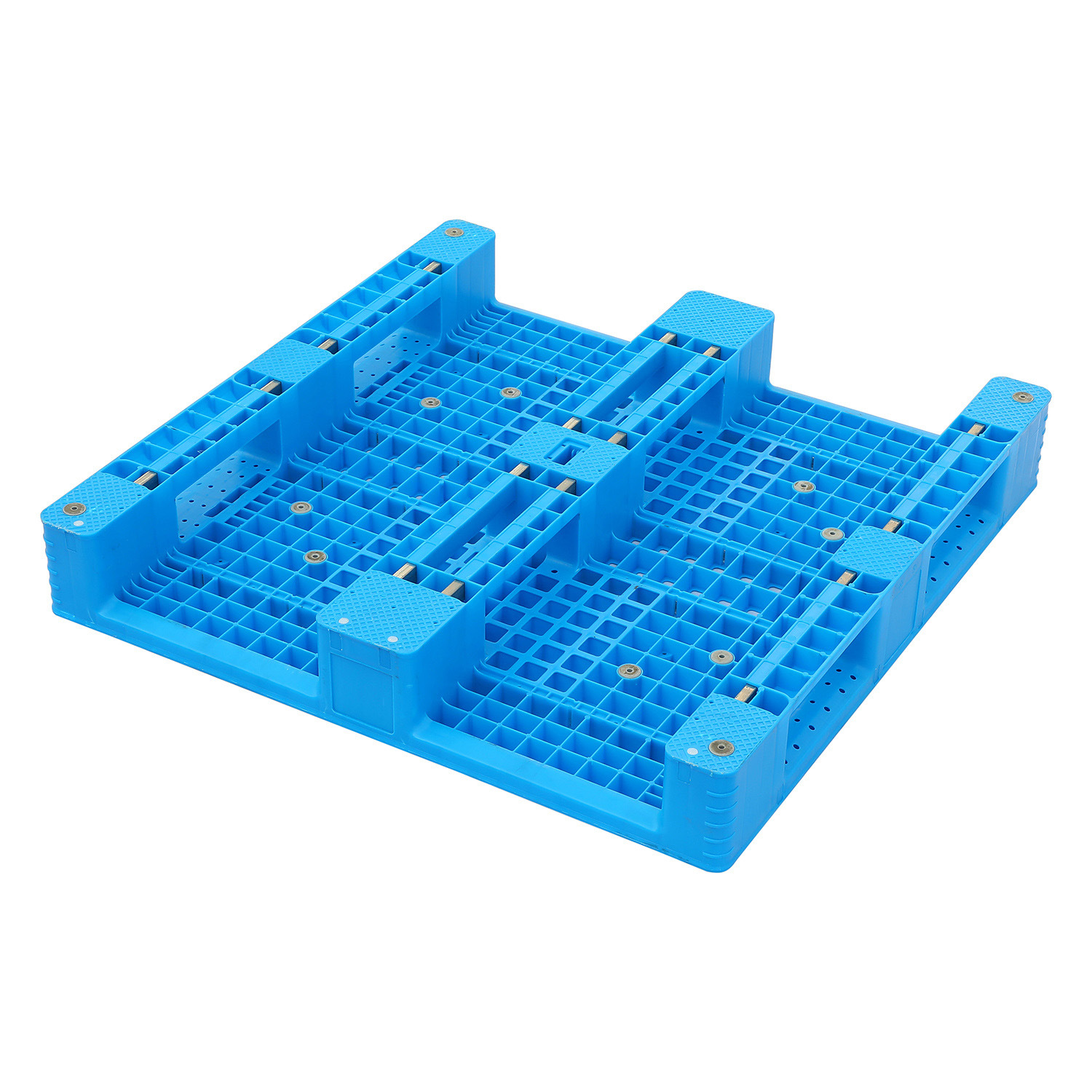
Underside view of a blue heavy-duty 3-runner plastic pallet, highlighting internal steel stiffener bars and anti-slip rubber grommets across the ventilated grid deck.
What Each Base Does With the Load
The bottom structure determines where the load goes once it leaves the deck. Three formats cover most warehouse work.
«Рулида» Сверхпрочный пластиковый поддон с 3 полозьями is a one-piece injection-moulded HDPE pallet with an open-grid deck, 4-way entry, TPE anti-slip blocks and, when specified, 8 to 12 galvanised steel tubes. The Сверхпрочная пластиковая паллета с 6 полозьями is moulded in HDPE or PP with a reinforced six-runner grid bottom, aimed at bagged goods stacking, cold storage and industrial cargo. The Легкий 9-ножной пластиковый поддон, вставляемый друг в друга is deliberately built light so that empty pallets take less space.
The published figures differ in a way that matters:
Two things in that table deserve attention before anyone treats it as a comparison. First, the 6-runner page does not publish a rack rating, so it should not be entered into a racking project on the assumption that its higher static load carries over. Second, the static load figure on the 6-runner and hygiene pallets — 6.0T — is a floor-stacking or evenly supported figure. It says nothing about what happens when the same pallet spans two beams with 1,000 kg on it.
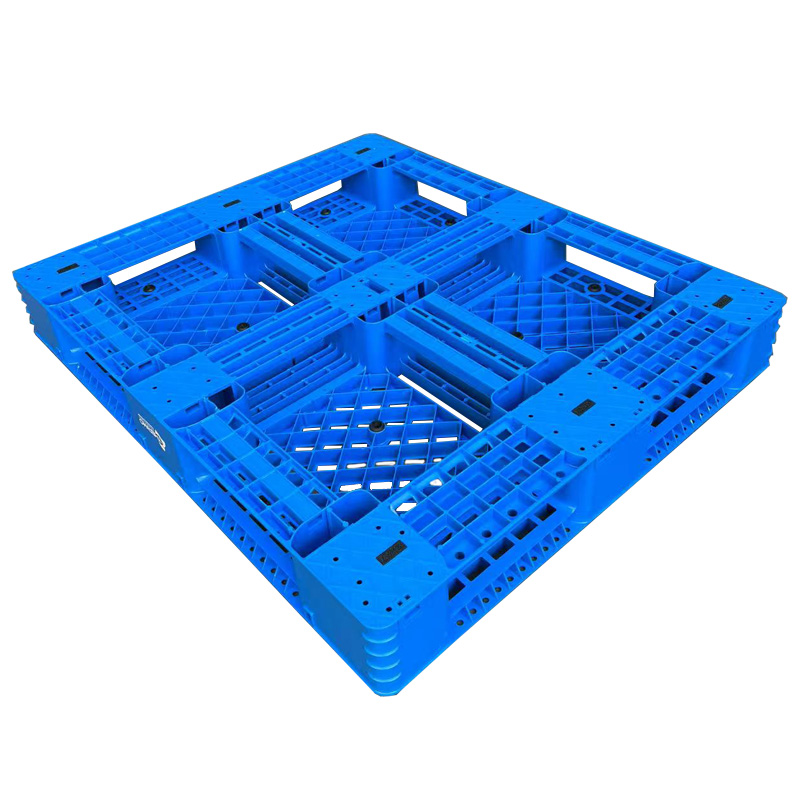
Underside view of a blue heavy-duty plastic pallet, highlighting its full perimeter cross-base framework, diagonal grid reinforcement, and integrated black anti-slip pads.
Rackable Plastic Pallet Ratings Depend on the Rack, Not the Pallet
A pallet in a rack is a beam. It has two supports, a span and a load, and its behaviour depends on all three.
The last row of that table is where most disputes start. A supplier can only rate what was tested, and a rating without the test configuration is a marketing number. ISO 8611-1:2025 sets out the flat-pallet test methods and separates them into nominal load testing, maximum working load testing and durability comparison testing. Those are three different questions. A durability test tells you how many cycles a design survives; a maximum working load test tells you what it carries. When a quotation gives one figure, ask which test produced it.
A note on where the number comes from: ISO 8611-1 also states that specific tests for determining load capacity do not replace field tests on the actual pallet design. That sentence is worth keeping in mind when a racking project is being signed off on catalogue data alone.
Steel Tubes: What the 8 to 12 Rods Actually Do
The steel tubes inside a reinforced rackable plastic pallet are not there to increase the static load on the floor. On the floor, the deck bears on the runners and the runners bear on concrete; the geometry already does the work. The tubes earn their place when the pallet spans a gap.
Put a reinforced and an unreinforced pallet of the same size across two beams and load both. The unreinforced deck bends between the beams and the load path moves outward toward the runners, which then carry more than their share. Add tubes and the deck behaves closer to a stiff plate: the bending is shared, the mid-span sag drops, and the pallet keeps its shape when the load comes off.
That is why the 3-runner page rates rack use as conditional — “supported when reinforced with galvanised steel tubes” — while the dynamic load figure is quoted as 1.5T to 2.0T “depending on steel tube configuration”. The tubes are the difference between a pallet that can go into a rack and one that should stay on the floor.
Three practical consequences:
- Tube count belongs in the drawing. Eight tubes and twelve tubes are different products with different ratings. If the drawing does not show the layout, the quotation is describing a family, not a model.
- Tube corrosion protection matters in wash-down areas. Galvanised tube inside a sealed pocket is normally fine; a tube pocket that fills with wash water and never drains is not.
- Tubes do not fix a bad beam plan. A pallet with twelve tubes on 1,300 mm beam centres is still spanning 1,300 mm.
Entry, Handling and the Equipment Around the Pallet
4-way entry appears on all three formats, but it is produced differently and it behaves differently with each handling device.
The 3-runner model uses TPE anti-slip blocks, which address the last row: a load that shifts on an open deck during transport is a wrapping problem and a pallet-surface problem at the same time. The 6-runner bottom, with its connected grid, presents a wider contact area to a conveyor or a floor, which is part of why it is specified for bagged goods and cold storage.
For a rackable plastic pallet used in ASRS, the job is repeatability. A stacker crane locates a pallet by its outer dimensions and its bottom face. A pallet that has crept under load, or one from a batch with a different runner thickness, will cause a fault that gets attributed to the crane. Keep a sample pallet from each delivery batch and measure it against the approved drawing.
Deck Choice: Open Grid or Solid
The deck is the surface the product touches, and the choice is driven by cleaning, drainage and labelling rather than by load.
«Рулида» Сверхмощный гигиенический поддон из твердого пластика is built around the solid-deck case: a fully closed top with a smooth surface, a dedicated sanitary tray, and no gaps or holes where dust, liquid or product can collect, so the deck can be washed and disinfected in one pass. For food and pharmaceutical storage that is the relevant specification, not the load number. Where the pallet will contact food directly or sit in a wash-down room, deck geometry decides whether a cleaning procedure can actually be executed.
If the pallet is part of a food-contact packaging chain, keep the compliance question at the right level. Resin grades intended for food contact are covered by regulations such as FDA 21 CFR 177.1520, which addresses the olefin polymers themselves; that is a material-level reference, not a certificate issued for a finished pallet. Ask the supplier for the documentation that applies to the exact grade and colour used in your order, and for the migration or declaration paperwork the destination market requires.
Empty Pallet Logistics and the Footprint Question
The 9-leg format exists for one reason: empty volume. Nesting pallets into each other reduces the space taken by the return leg, and that is often the largest cost line in a pooled or closed-loop system.
Footprint is the second half of this decision. ISO 3394:2012 defines rigid rectangular package dimensions on 600 × 400 mm, 600 × 500 mm and 550 × 366 mm modules, and it refers back to the four unit-load plan dimensions in ISO 3676: 1,219 × 1,016 mm, 1,200 × 1,000 mm, 1,200 × 800 mm and 1,100 × 1,100 mm. Rulyda’s pallet sizes map onto those series. If your customer’s distribution centre is planned around one of them, choose the pallet that divides into it cleanly — a pallet that misses the module by 50 mm wastes that 50 mm on every trailer and every rack bay.
One caution on labels: the hygiene pallet page describes its type as “Euro Pallet” against a 1200 × 1100 mm external size. The Euro footprint is 1200 × 800 mm, so check the actual footprint you need against the drawing rather than the type name. If you need the 1200 × 800 module, ask for it explicitly.
A Verification Protocol Before the First Bulk Order
The sequence below is the one that catches most of the problems, and it can be run with two pallets and a tape measure.
Step 4 is the one buyers skip most often, and it is the only step that puts a rackable plastic pallet on your rack at your beam spacing. A pallet that deflects 15 mm on a 1,000 mm span may still pass a formal load test and still foul the beam on a 1,200 mm span.
Часто задаваемые вопросы
Q: Can I use a 6-runner pallet in a rack? A: Possibly, but the product page does not publish a rack rating for that model, so do not assume one. Ask for the rack load with the beam spacing it applies to. If racking is the main use, the 3-runner reinforced rackable plastic pallet is the format with a stated rack condition.
Q: What is the difference between static load and rack load? A: Static load is what the pallet carries on a flat floor with the load evenly supported. Rack load is what it carries spanning between two beams with the ends hanging or sitting on the beam. The second number is always lower, and it depends on the span. A 6.0T static figure and a 1.5T rack figure on the same pallet are not contradictory.
Q: Do I need steel tubes if the pallet only goes on the floor? A: No. On the floor the runners do the work. Tubes are for spanning, for high stacking and for absorbing impact at the entry openings. If your operation never racks the pallet, spend the money on the deck surface instead.
Q: How many tubes should I specify? A: Between 8 and 12 depending on the load requirement, and the right number comes out of the beam span and the load, not out of a preference. Ask for the count to be shown on the drawing with the resulting rating.
Q: Can the same pallet go from a freezer into an ambient trailer? A: Mechanically, yes, but the rating was set at a temperature. Stiffness falls as the material warms, and a pallet used at its limit in a cold store should not be assumed to hold the same load at 35 °C. Tell the supplier the highest temperature the loaded pallet will see.
Q: Is a nestable 9-leg pallet suitable for automated storage? A: Generally not. Nesting depends on the feet dropping into the pallet below, which is the opposite of the flat, repeatable bottom face a stacker crane needs. Use nesting for empty returns and light storage.
Сопутствующие товары
Each rackable plastic pallet format above differs in load path before it differs in price. Custom footprints, colours, logo marking and steel tube configurations are handled through the Решение для OEM-производителей route, and the full pallet range sits under Пластиковый поддон.





 2026/10/22