Quick Answer for Buyers
Most wheeled bin procurement problems show up the same way: a lid that won’t engage the auto-lift arm, a body that cracks after 18 months in direct sun, or a wheel axle that fails on a loaded 660L unit. All three trace back to buying decisions made before the bins left the factory — the EN840 certification level, the HDPE material grade, and the axle spec. This guide covers what to check on each.
The EN840 Problem Nobody Mentions Until Tender Day
EN 840 is the European standard that defines how a wheeled bin interacts with a collection truck’s lifting mechanism — lid geometry, body dimensions, emptying compatibility. It’s the baseline spec for municipal procurement across the EU, UK, and GCC. Most buyers know this. What catches people out is the difference between a supplier claiming “EN840 compliance” and actually holding a test certificate for the specific model on the purchase order.
Those are two different things. Series-level claims don’t cover model-level variations in lid hinge position, body taper, or axle height — all of which affect whether the lifting arm actually engages cleanly. When a non-compliant bin jams an auto-lift mechanism on a collection route, the truck stops. The driver gets out. The collection schedule slips. The municipality calls the procurement team.
The practical fix is a single question: Can you issue an EN840 test report for the exact model number on the PO? If the answer involves hesitation or a redirect to a catalog page, that’s the answer.
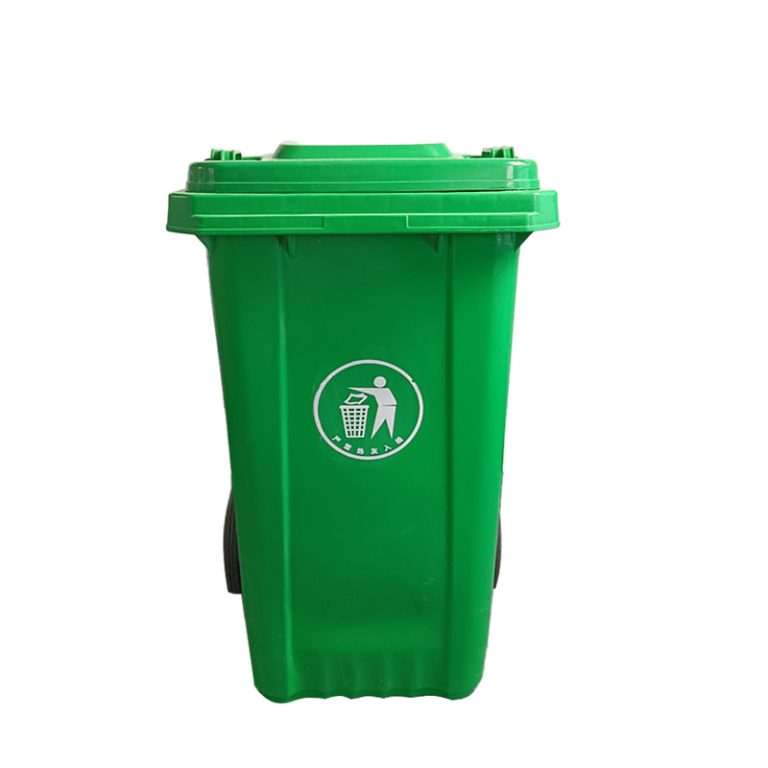
Rulyda’s wheeled bins are EN840-certified across the full 120L–1100L range. The hinged flip-top lid is specifically designed for auto-lift compatibility — not generically “compatible,” but tested against the standard.
For reference: the 240L unit is the standard size in most European municipal fleet tenders. It’s emptied daily on most routes and sees the highest lift cycle count of any bin in a fleet. If one size needs a hard certification check, it’s this one.
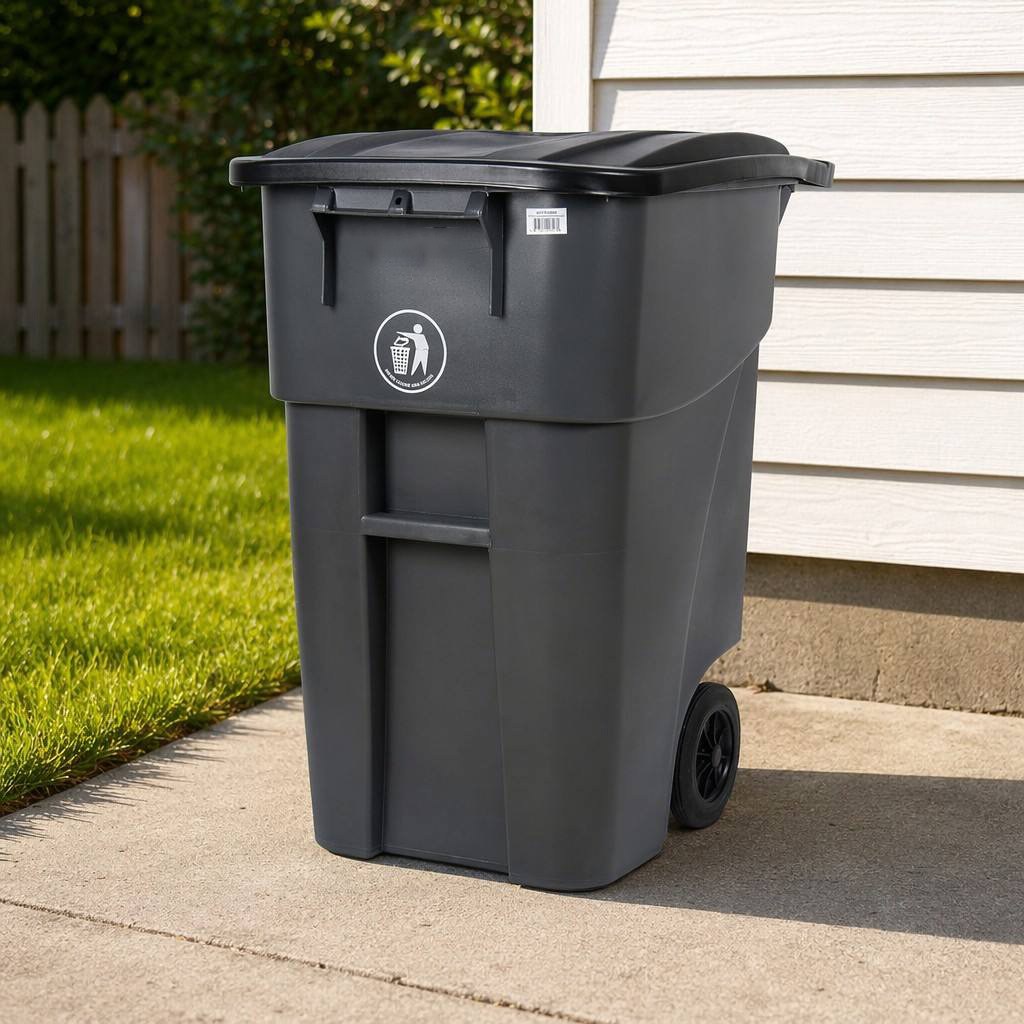
An unbranded dark charcoal-grey HDPE wheeled waste bin positioned on a sunlit concrete residential driveway, featuring an integrated front handle, recessed central reinforcement panel, dual multi-spoke rear wheels, and a retail-ready barcode label — photographed in a suburban context with shallow depth of field for clean catalog presentation.
What Happens to Cheap Bins in Hot Climates
A waste bin sitting in Riyadh, Lagos, or Bogotá gets roughly 10–12 hours of direct sun per day. Unstabilized HDPE absorbs UV radiation and oxidizes — not immediately, but consistently. The first sign is surface chalking and color fade. Then micro-cracking along the body corners. Then, usually in year two, a structural failure at a stress point: a lid hinge that snaps off, or a body wall that splits when the lifting arm applies lateral force.
UV stabilizers are added to the resin before molding, not applied as a surface coating. The difference matters because a surface treatment degrades with washing and abrasion; a stabilizer compounded into the polymer matrix stays active for the life of the bin. Rulyda’s bins use 100% virgin HDPE with stabilizers built into the material, rated for -25°C to +50°C across a 3–5 year outdoor service life.
The material grade also matters for a separate reason. Recycled-content HDPE comes from mixed polymer streams — source material that could have been automotive parts, household chemicals, or industrial components. Under UV stress, the performance is harder to predict and harder to certify. Virgin HDPE comes with a material certificate per batch. If your buyers in Europe or the GCC ask for material traceability documentation, virgin material is what makes that possible.
The Part That Actually Breaks: The Wheel Axle
Fleet supervisors who manage large bin inventories will tell you the body rarely fails first. The wheel assembly does.
Lower-cost bins use hollow plastic pins or bolt-on casters. A 660L bin fully loaded weighs several hundred kilograms. Rolling that across concrete, asphalt, or a logistics yard daily — the pins fatigue. When they fail, the bin can’t roll. A bin that can’t roll gets dragged. Dragging is where both the bin and the worker get damaged.
Rulyda’s commercial and municipal bins use solid rubber wheels on a continuous galvanized steel axle. The load distributes across both wheels instead of concentrating at bolt points. A single operator can move a fully loaded bin over uneven ground without the axle flexing or the wheel bracket cracking.
It’s worth asking any supplier to confirm the axle material in their technical datasheet — not in their marketing materials, in the datasheet. Suppliers who use solid metal axles are generally willing to say so in writing.
Lid Type and Color: Two Details That Matter More Than They Used To
Depending on where the bins are deployed, lid design is becoming a compliance question rather than a preference.
In food processing facilities, hospitals, and hospitality venues, hands-free waste disposal is increasingly required under food safety and infection control standards. A pedal-open lid — where the operator steps on a foot lever to open the bin — keeps hands off the waste opening entirely. It’s not a premium feature; it’s what auditors look for in hygiene-sensitive environments.
For standard municipal outdoor collection, the hinged flip-top lid remains the right choice: weather-sealed, wind-resistant, and compatible with auto-lift trucks.
| Deckeltyp |
Best For |
Key Feature |
| Hinged flip-top |
Municipal routes, outdoor public areas |
Auto-lift truck compatible, wind-resistant |
| Pedal-open |
Food processing, healthcare, hospitality |
Hands-free, hygiene-audit compliant |
On color: European and GCC waste-sorting regulations now commonly require different colors per waste stream — organic, recyclable, general, hazardous. A bin supplier that supports custom RAL color matching and color-coded lids lets a municipality implement sorting compliance with a single vendor rather than patching together different bin lines. Rulyda supports custom colors, color-coded lids, and logo printing via screen printing, heat transfer, or self-adhesive labels.
Choosing the Right Capacity
The mistake most procurement teams make is sizing bins to estimated waste volume. The more reliable method is sizing to the emptying frequency — how often the truck can realistically service each collection point.
| Kapazität |
Where It’s Used |
Emptying Frequency |
Notes |
| 120L |
Parks, pedestrian zones, small retail |
High frequency, manual or small auto-lift |
Lighter-duty access points |
| 240L |
Municipal curbside (EU standard) |
Daily, auto-lift side-loader |
Highest EN840 compliance priority |
| 360L |
Apartment blocks, mid-size commercial |
2–3× per week |
Balances capacity with maneuverability |
| 660L |
Industrial yards, large commercial sites |
Weekly |
Solid steel axle is critical at this size |
| 1100L |
Bulk collection stations, logistics hubs |
Scheduled heavy lift |
Largest single-unit capacity in the range |
A bin sized too large for its route sits full between collections and creates hygiene problems. One sized too small means more truck visits per week — higher cost per tonne collected. The emptying cycle is the more reliable anchor for the decision.
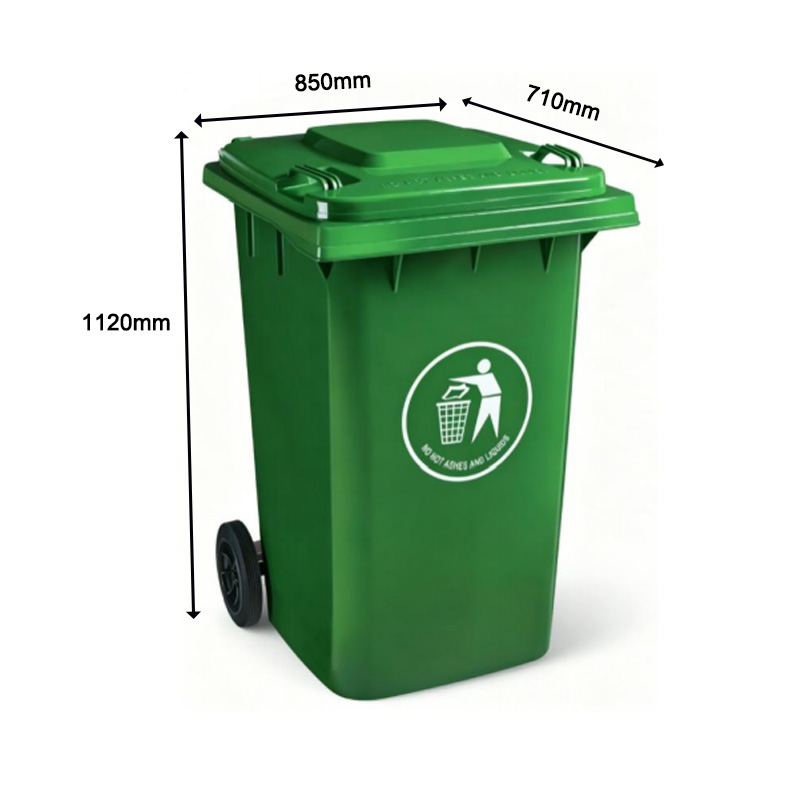
Metric dimension sheet of a 1120mm-tall green HDPE wheelie bin shown in three-quarter view, featuring a hinged lid with molded grips, dual rear wheels, and a prominently displayed “NO HOT ASHES AND LIQUIDS” safety emblem on the front panel.
Four Things Worth Confirming with Any Supplier
- EN840 test certificate for the specific model on the PO — not a series claim, a model-level test report.
- Virgin HDPE with UV stabilizers, with material certificate per batch — important for high-sun markets and for buyers with EU or GCC regulatory requirements.
- Axle material: solid continuous steel or bolt-on plastic — ask for it in the technical datasheet, not the product page.
- Custom RAL color and color-coded lid support — useful if sorting compliance is on your horizon or your client’s.
About Rulyda Plastic
Qingdao Rulyda Plastic Manufacturing Co., Ltd. has been making injection-molded plastic products since 2009. The factory runs 50+ automated production lines in a 20,000 sqm facility, located 30 km from Qingdao Port. The waste bin line covers three models:
- Heavy-Duty Outdoor-Mülleimer auf Rädern — EN840-certified, 120L–1100L, UV-stabilized virgin HDPE, hinged auto-lift-compatible lid, solid rubber wheels with reinforced steel axles. MOQ 50 pcs (green stock), 300 pcs for custom colors.
- Gewerblicher Mülleimer mit Rädern — square-profile pedal-open bins for food processing, healthcare, and hygiene-sensitive municipal sites. Galvanized steel axle. OEM/ODM supported.
- Outdoor Plastic Wheelie Bin (R-240) — 120L to 1100L, hinged or pedal-open lid options, for municipal, industrial, and commercial applications.
All three carry EN840 and CE certification, manufactured under ISO 9001. Samples in 3–5 working days; bulk orders in 5–7 working days.
For quotes, tender specs, or OEM inquiries: [email protected] | WhatsApp/WeChat: +86 136 8532 6369 | Tel: +86 532 68975312
Häufig gestellte Fragen
Q: What does EN840 certification actually cover?
A: EN 840 is the European standard for mobile waste containers. It sets the dimensional and structural requirements that allow a bin to be lifted and emptied by a compliant collection truck’s automated system. Municipal tenders in the EU, UK, and GCC routinely require it — specifically at the model level, not just the product series.
Q: What capacities does Rulyda make waste bins in?
A: 120L, 240L, 360L, 660L, and 1100L. The 240L is the most common in European municipal fleets; the 660L and 1100L are built for commercial and industrial sites where bulk collection is scheduled rather than daily.
Q: How long will outdoor bins last in a hot climate?
A: With UV-stabilized virgin HDPE, the rated outdoor service life is 3–5 years across a -25°C to +50°C range. Bins made from non-stabilized or recycled-content plastic tend to show cracking and structural failure within 18 months in high-UV environments like the Middle East or equatorial Africa.
Q: Are Rulyda’s bins compatible with automated collection trucks?
A: Yes — the hinged flip-top lid is designed for auto-lift compatibility and the series is EN840 certified. If your trucks run a specific lift system, ask for the EN840 test report for the model you’re ordering and confirm the lid geometry against your truck spec.
Q: Can I get custom colors and branding?
A: Yes. Standard green is in stock. Custom RAL colors and color-coded lids are available from 300 pcs. Logo branding is done via screen printing, heat transfer, or self-adhesive labels depending on the application.
Q: What’s the MOQ and how long does production take?
A: 50 pcs for stock green; 300 pcs for custom colors. Sample lead time is 3–5 working days. Bulk production is 5–7 working days.












 2026/08/21