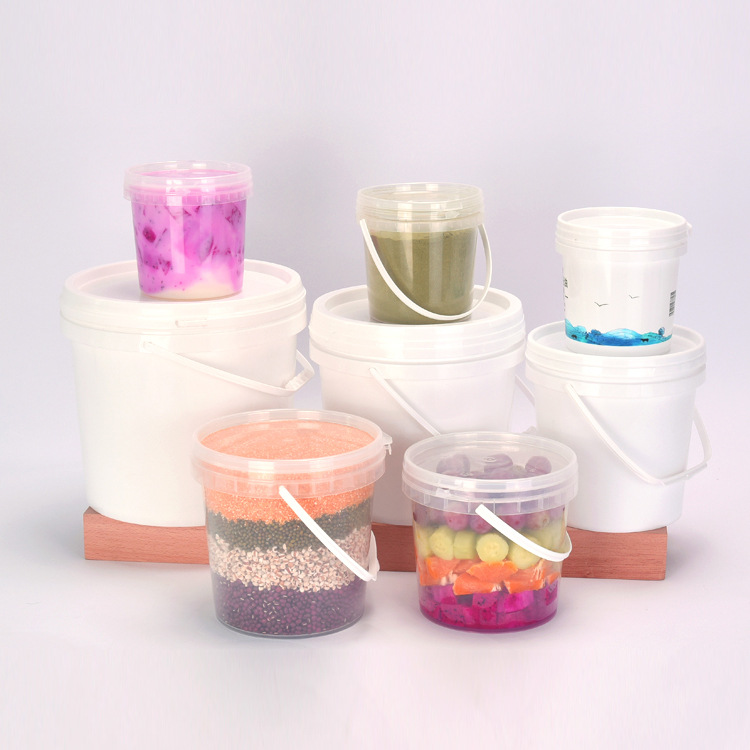
Square plastic buckets and round pails can carry the same nominal capacity and still produce very different numbers on a pallet plan, a filling line and a retail shelf. Rulyda moulds both formats — square buckets across a 1L to 20L range and round pails from 350ml upward — and most of the geometry questions that reach our technical sales desk come down to a handful of measurable trade-offs rather than a preference for one shape.
Quick Answer for Buyers: Square plastic buckets and round pails with the same nominal capacity are not interchangeable. Square bodies pack without the dead space left between round units, so more litres fit on a pallet, a shelf or a truck, and flat panels give IML or silk-screen artwork a full uninterrupted face. Round pails suit rotary filling lines, viscous or aerated products and smooth drainage. Choose square when pack density, shelf appearance and decoration area drive the margin; choose round when fill behaviour or an existing round line matters more.
A square bucket is not automatically the better purchase, and a round pail is not automatically cheaper to run. What changes is where the cost and the handling effort sit. The rest of this article separates those factors so that an RFQ can be built on measurements, not on the shape of a catalogue photo.
Where Square and Round Pails Actually Diverge
Both formats are injection moulded from PP and both use tamper-evident lids and ergonomic handles. The geometry changes six things a buyer can measure before placing an order: layer density, usable artwork surface, lid type, fill behaviour, stack load path and cleaning access.
The product page is the starting specification, not the final word. Outside dimensions, lid overhang and the exact rim profile determine how a filled bucket performs, and those details belong on the model drawing you approve with the sample.
Pack Density: Where the Square Body Earns Its Keep
The practical argument for a square bucket is layer efficiency. Two containers of equal capacity can occupy very different amounts of a 1200 × 1000 mm pallet, and that difference repeats on every pallet, every truck and every shelf facing.
Treat those percentages as geometry, not as packing figures for a specific bucket. The π/4 relationship describes how circles tile a plane; it does not account for handle protrusion, lid diameter, taper or wall thickness. Ask for units per layer for the exact model before you build a freight or storage calculation on it.
If your downstream customer is a retail distribution centre, the plan dimensions matter as much as the count. ISO 3394:2012 sets out dimensions for rigid rectangular transport packages based on a 600 × 400 mm, 600 × 500 mm or 550 × 366 mm module, and it refers to the unit load footprints defined in ISO 3676 (1219 × 1016 mm, 1200 × 1000 mm, 1200 × 800 mm and 1100 × 1100 mm). A square bucket footprint that divides into the pallet the customer already uses is easier to slot into an existing planogram than a round unit that leaves a margin of unusable air.
Current square bucket formats include the 2L Square Plastic Bucket, the 8L Square Plastic Bucket and the 20L Square Plastic Bucket, which lets a brand standardise on one shape across a size ladder instead of mixing formats between SKUs.
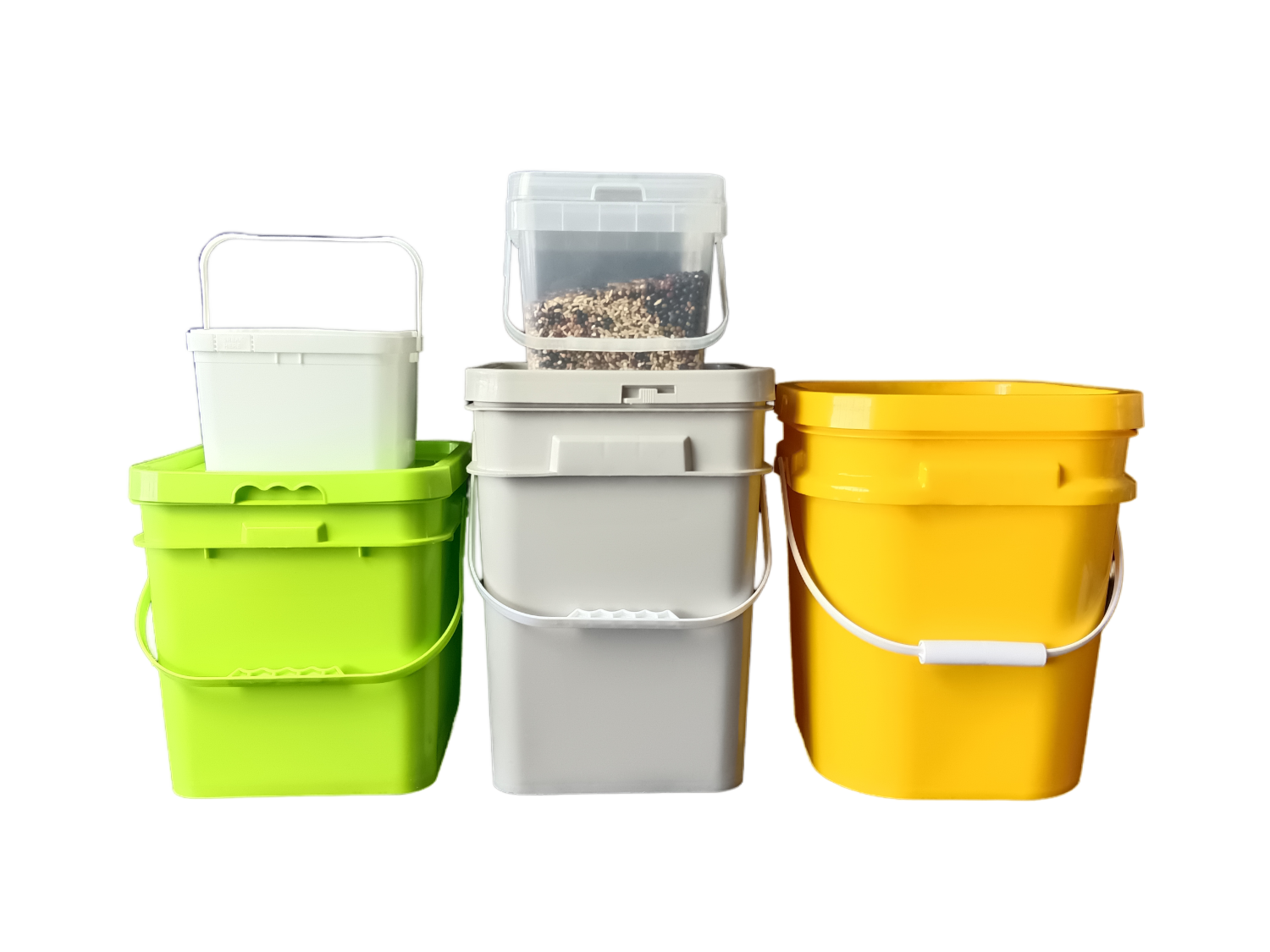
PP plastic buckets in lime green, grey, yellow, and transparent — square and round styles with handles, shown in two sizes stacked for compact display. Demonstrates custom color and multi-style supply capability for food storage, pet feed, agricultural, and general bulk packaging applications.
Lid Systems Are Not Interchangeable Between Formats
A lid is matched to the rim it seals. The closure on a round pail will not fit a square bucket of similar capacity, and a lid approved for one model should not be assumed to fit another model in the same family.
Tamper evidence and re-closure pull in opposite directions. A pull-strip or tear-strip design proves first opening but is not built for repeated reopening. If the end user reseals the bucket in daily use, specify that behaviour in the RFQ and test it, rather than assuming the production lid will hold up to it. A braided rope handle such as the Rope model is a separate accessory decision and follows the same rule: confirm the fit against the bucket body, not against a similar-looking photograph.
Fill Behaviour and Filling-Line Fit
Shape affects how product enters the bucket, how much air is trapped and how much product stays behind when the bucket is emptied.
If your line is already tooled for one format, the changeover cost usually sits in the change parts, not in the bucket. Ask for a sample so the capping head, rail width and nozzle position can be checked against the real body before a bulk order is placed.
Decoration and Labeling: What Each Surface Allows
Rulyda’s bucket pages list IML, heat transfer printing and silk-screen printing, supported by in-house mould development. Which method makes sense depends on the surface it has to sit on.
A flat panel also gives a predictable scan plane for an on-pack barcode, which helps when the bucket is scanned at a retail or distribution handover. GS1 publishes the barcode standards and the general specifications that define how those symbols are built, if the private label needs to be scan-ready on arrival.
Colour is a separate specification from decoration. Confirm the target shade against an approved physical sample or a Pantone reference, and identify the colour masterbatch in the documentation pack so the destination market’s declaration can be traced to the material actually moulded.
Stacking and Load: Verify the Number, Not the Brochure
Load figures are model-level ceilings. They are useful for narrowing a shortlist and misleading if they are read as a recommended fill weight. As an example from our own range, the 5 Gallon Plastic Bucket with Lid page states virgin polypropylene, a 2mm wall and a maximum load capacity of 36 kg. That 36 kg belongs to that model and configuration; it is not a target fill weight for a sauce, a paste or a product that will be stacked three high in a warm warehouse.
Where Round Pails Stay the Better Choice
Round is not the weaker format. It wins in specific situations:
- The filling line is already set up for round bodies and the change parts would cost more than the density gain.
- The product is viscous, aerated or likely to cling, and corner voids or residue would create a measurable yield loss.
- Smooth internal drainage matters because the bucket is washed and reused on site.
- The bucket is part of an existing public-facing shape family and switching would fragment the branding.
- Portion sizes are small. Rulyda’s round range starts well below one litre, which suits condiment, dairy and sample packaging where the square format would be disproportionate.
Formats in the round range include the 350ml Round Plastic Bucket, the 500ml Round Plastic Bucket, the 760ml Round Plastic Bucket and the 1L Plastic Bucket, so a private-label programme can run small portion packs and larger square bulk packs from the same supplier.
What to Put in a Bucket RFQ
A useful RFQ states:
- Product to be filled, and whether it is liquid, paste, powder or solid.
- Target nominal capacity and the fill weight you intend to run.
- Preferred shape, and what happens if the supplier recommends the other format.
- Required outside dimensions or the pallet footprint the bucket has to divide into.
- Pallet size, units per layer and planned stack height.
- Filling method, nozzle position and expected line speed.
- Whether end users reseal the bucket after first opening.
- Decoration method and the artwork surfaces available.
- Colour reference and whether a batch-to-batch match is required.
- Cleaning and reuse regime, if the bucket is not single-trip.
- Destination market and the material documents that market expects.
- Sample validation procedure before bulk approval.
Order quantity and production timing should be confirmed against the selected size, colour, decoration method and destination rather than fixed in an article. Rulyda supports full OEM and ODM configuration, including custom size, structure, colour, logo and mould development for non-standard dimensions.
Material and Compliance Documents by Destination Market
Rulyda’s bucket pages state that the range is produced with food-contact compatible material and is supported by EU food-grade testing, SGS testing and California Proposition 65 compliance documents. Those are supplier statements about a programme; the document file for your order still needs to name the material actually used.
Two practical points follow. First, colour masterbatch is part of the food-contact assessment, so a colour change is a documentation event, not only a production change. Second, a declaration that names a generic material without the tested configuration is of limited use in a customer audit. Ask for the document that matches what you are buying.
Regulatory pages worth reading in full: EU Regulation (EU) No 10/2011, FDA 21 CFR 177.1520 and the California Proposition 65 programme.
The published articles on FDA-certified plastic buckets and on the 5-gallon bucket across three industries cover the compliance and end-use angles in more detail; this article stays on the geometry decision.
Related Products
Frequently Asked Questions
Q: Will a square plastic bucket always fit more units on a pallet than a round pail of the same capacity?
A: Usually yes, but not automatically. Flat walls remove the gaps that round bodies leave, yet the gain depends on the actual outside dimensions, lid overhang and the pallet you are loading. Ask for units per layer for the exact model, and check it against your pallet plan before you treat the difference as a freight saving.
Q: Can we use the same lid on a square bucket and a round pail?
A: No. A lid is matched to the rim geometry and to the specific model, so lids are not interchangeable between formats even at the same nominal capacity. If you need one lid specification across a size ladder, confirm the compatible bodies with the supplier and keep the lid SKU on the approved sample.
Q: We already run a round filling line. Is switching to square worth it?
A: It depends on where your cost sits. If change parts, capping heads and rail settings would need re-tooling, and your product is viscous, the density gain may not cover the disruption. Run a sample bucket through the line and compare changeover effort against the units-per-pallet gain before deciding.
Q: Do we need a different decoration method for a round pail?
A: Not necessarily the same artwork, but the method should be re-checked. A flat panel on a square bucket can take IML artwork edge to edge; a round body usually needs the label to follow the curve or the print to sit in a defined band. Confirm the method against the actual body and your wash or cold-chain conditions.
Q: Are Rulyda square plastic buckets food-contact compliant?
A: Our product pages state food-contact compatible material with EU food-grade testing, SGS testing and California Proposition 65 documentation. Compliance for your order should still be confirmed through documents that name the resin, colour masterbatch and configuration being supplied, and that match your destination market’s requirements.
Q: What should we test before ordering bulk plastic buckets?
A: Test the fill weight, the capping or lidding step, the loaded stack at the planned height, lid re-closure if the bucket is reused, the wash cycle, artwork legibility and the pallet layout. Run the sample through the same line, warehouse and transport steps the production order will follow.
Request a Bucket Recommendation
Send Rulyda Plastic your product type, target capacity, fill weight, pallet plan, decoration requirement, colour reference, reuse or single-trip intent and destination market. The technical sales team can recommend a square, round or clear configuration, provide a model drawing and supply samples for line and stacking trials. Clear-body options are worth including in the comparison when contents inspection matters, as described on the Clear Plastic Bucket page.
Contact: [email protected] WhatsApp / WeChat: +86 136 8532 6369





 2026/10/15