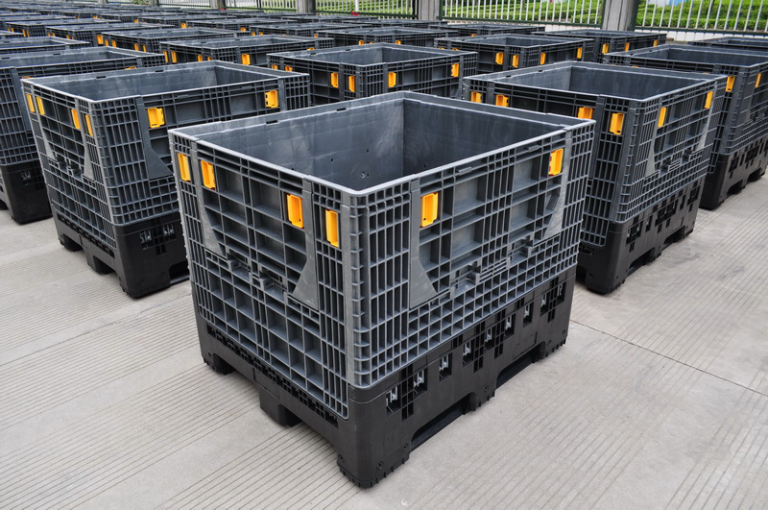
Plastic pallet box load capacity is usually passed to buyers as a single number in a quotation, and that is where bulk container projects start to drift. A 1200 × 1000 mm pallet box can be rated 4,000 kg on a warehouse floor, 1,000 kg on forklift tines and roughly 700 kg on a rack beam. Those are three different products as far as the load path is concerned, and a specification written around the largest figure is the one most likely to fail in service.
Quick Answer for Buyers: Plastic pallet box load capacity is not one figure. Static load is the ground-stacked weight the base can hold without deformation; dynamic load is the weight safe to move by forklift or pallet jack; racking load is the lower figure allowed when the box rests on rack beams. Specify the operating load first, then verify base design, side panel type, material grade and stacked height with the supplier. For racking installations, ask for rack load separately and confirm the figure applies to your load distribution rather than a uniform test block.
The confusion is easy to explain. A sales quotation usually repeats whichever number is largest, because that number sells. But the same container is asked to do three different jobs on any given day: sit on a floor as the bottom unit of a stack, travel on a forklift, and spend months loaded on a rack beam. Each job changes how the weight reaches the base.
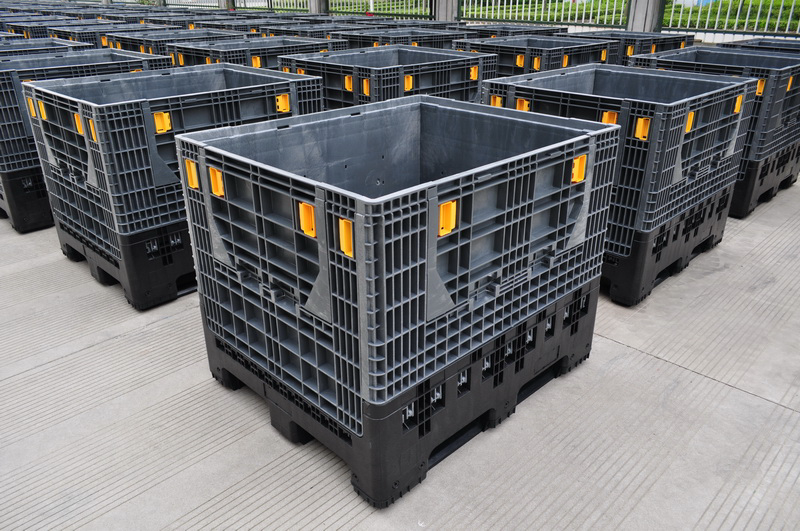
Multiple heavy-duty foldable plastic pallet containers arranged outdoors, showing reinforced ribbed side panels, bright yellow folding latches, and integrated four-way forklift entry bases.
Load Capacity Is Three Numbers, Not One
The ratings below are not competing claims. They describe different support conditions, and the lowest one that matches your operation is the number that governs your order.
Rulyda’s unfoldable pallet box page (HVC-1210 series) publishes all three figures for the same 1200 × 1000 mm container: 1 ton dynamic, 4 tons static, and 0.7 ton rack load for racking-compatible models. The base, the material and the footprint do not change between those numbers. Only the support condition does.
On a floor, the load travels through the runners or legs into the ground across the full footprint. On a rack, the box touches only two beams, so the weight concentrates on a narrow band and the base has to work as a beam rather than a plate. Combined with months of sustained loading, that is a different engineering problem, and the rating drops accordingly.
Base, Panel and Material Decide Which Rating You Get
Two pallet boxes can share a footprint and still carry different loads, because the base and the panels are where the load path is built.
The steel-pipe reinforced base is the option to raise first when a rack load requirement is close to the published figure. Changing the panel type is usually a hygiene and handling decision rather than a capacity decision.
The Foldable Model Carries a Different Rating Set
Rulyda’s foldable plastic pallet box is a separate product from the fixed-wall model, and its published figures should be read on their own terms. Height options run from 590 mm to 1000 mm, net weight is around 55 kg with a tolerance of ±2 kg, and the folding ratio is approximately 4:1, with a 1000 mm unit folding to roughly 250 mm. Static load is listed at 4,000 kg and dynamic load at 1,000 kg.
The Caisse palette pliable en plastique suits operations that reuse containers in a managed loop, where empty units return regularly and folded volume reduces return freight. The Caisse palette en plastique dépliable is the fixed-wall option for buyers who prioritise structural permanence, dust and moisture protection, and predictable stiffness under a permanent load. Both are listed under the Caisse palette en plastique category, and the earlier foldable vs fixed engineering comparison covers the architecture decision.
One detail is worth checking on either version: the foldable page states a virgin-material service life of 3 to 5 years and a blended-material life of 1 to 3 years. Treat those as manufacturer’s product-page figures for comparison, not as a guarantee for your application. Load level, handling roughness, cleaning chemicals and UV exposure will move them.
What the Standards Cover, and What They Leave to You
The ISO 8611-1:2025 standard, Pallets for materials handling — Flat pallets — Part 1: Test methods, sets out the test methods for evaluating new flat pallets, grouped into nominal load testing, maximum working load testing and durability comparison testing. The standard is useful because it defines how a load rating is established rather than what the rating should be.
It also states its own boundary clearly: it does not apply to pallets with a fixed superstructure or a rigid, self-supporting container mechanically attached to the pallet that contributes to the pallet’s strength. A pallet box is exactly that assembly. So a pallet test report alone does not certify a pallet box, and a supplier should be able to explain how the container figure was arrived at. The standard also notes that specific load tests do not replace field tests on a particular design, which is the practical argument for running a loaded trial before bulk approval.
If wood pallet boxes are still on the shortlist, ISPM 15 is the other standard to know. It describes phytosanitary measures for wood packaging material in international trade, and it covers dunnage made from raw wood while excluding processed materials such as plywood. Injection moulded plastic containers sit outside that treatment and marking requirement entirely, which is one reason they are easier to move across borders without a heat-treatment certificate trail.
For returnable fleets, the GS1 Global Returnable Asset Identifier gives a way to identify reusable containers by type, or individually when sorting and tracking matter. Deciding the identification method early is cheaper than retrofitting labels onto a container that already has a printed nameplate.
Validate the Number Before Bulk Approval
A pallet box load rating is a starting point for testing, not a substitute for it. The list below reflects what buyers normally need to close out a bulk container order.
Tests are most useful when they reproduce the worst realistic day: the heaviest planned payload, the longest rack dwell time, and the roughest handling the box will see. A uniform block load on a level floor tests the base, but it does not test what happens when a pallet-jack corner lifts first.
FAQ
Q: Can I use the static load rating for a racking installation? A: No. Static load assumes full support underneath. A rack gives support at two beams only, so the rack load is the governing figure and it is normally much lower. Ask for the rack rating in writing for the exact model and base option you are considering.
Q: The foldable and fixed pallet boxes have the same footprint, so are their loads the same? A: Not necessarily. Check both data sheets model by model. Rulyda’s foldable page lists static and dynamic load, while the fixed-wall HVC-1210 series also publishes a rack load. If racking matters, that difference decides which one you can use.
Q: How much can I really stack on the bottom box? A: Divide the relevant rating by your real payload weight, then round down. A 250 kg payload against a 0.7 ton rack load gives two boxes per level, not three. Height clearance, ceiling height, stack stability and lift-truck reach usually reduce the practical number further.
Q: Does a lid make the box stronger? A: A fitted lid improves top-stack stability, keeps dust and moisture out and gives a flat surface to stack on. It does not increase the base or rack capacity, which comes from the base structure and material.
Q: Is a plastic pallet box subject to wood packaging treatment rules? A: No. ISPM 15 covers wood packaging material made from raw wood in international trade. Injection moulded HDPE or PP containers are outside that scope, so they do not need heat-treatment or fumigation marking. That is usually a paperwork advantage rather than a performance one.
Q: What documentation should come with the load figure? A: Ask for a model-specific data sheet naming the base configuration, panel type, material grade and the static, dynamic and rack figures, plus any internal test record. If the figures cannot be tied to a specific configuration, they are not usable for a procurement decision.
Produits apparentés
Caisse palette pliable en plastique — collapsible bulk container with height options from 590 mm to 1000 mm, roughly 4:1 folding ratio and a 4,000 kg static / 1,000 kg dynamic rating. Built for closed-loop operations where empty units return. View product
Unfoldable Plastic Pallet Box (HVC-1210 series) — fixed-wall 1200 × 1000 mm container in 760 mm and 800 mm heights, with mesh, sealed or sealed-with-door panels, and published ratings of 1 ton dynamic, 4 tons static and 0.7 ton rack load. View product
Heavy-Duty Hygiene Solid Plastic Pallet — rackable pallet platform for hygienic storage and distribution where the container body is not required. View product
Specifying Your Pallet Box
Send us the payload weight, the support condition, the stack height and the handling method, and we will match a pallet box configuration to those figures rather than to a single headline number. Base structure, panel type, material grade, lid option, colour and logo are all configurable, and custom sizes can be developed through our in-house mould design team under the OEM solution programme. MOQ and delivery schedule are confirmed against the final configuration and approved sample drawing.
For racking projects, tell us the beam span and level spacing in the same message. It shortens the technical review considerably.
Rulyda Plastique — Qingdao Rulyda Plastic Manufacturing Co., Ltd. · [email protected] · WhatsApp/WeChat +86 136 8532 6369 · +86 532 68975312













 2026/10/09