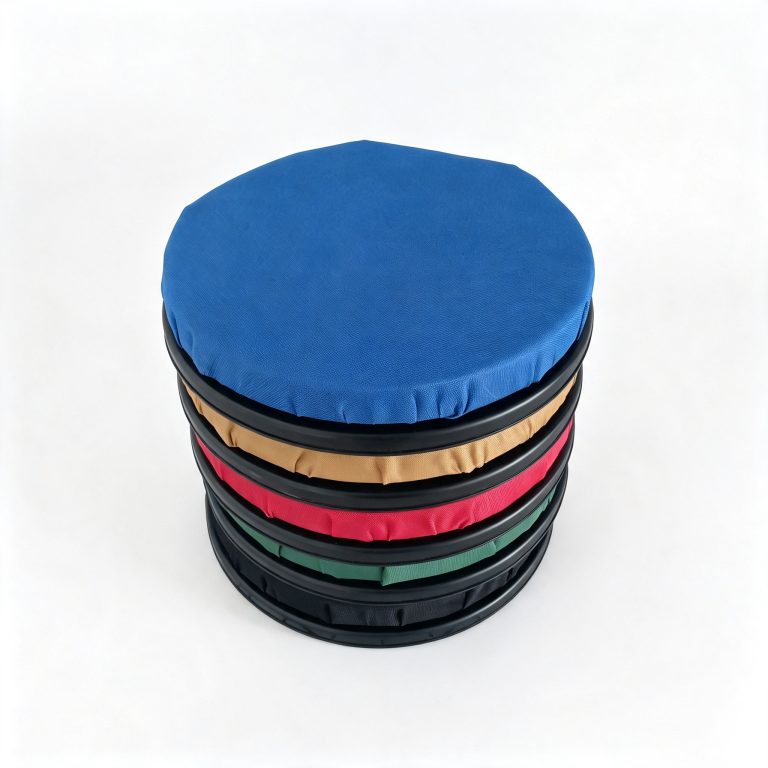
Two quotes come back for the same STEP file, far apart on price, and both say “custom tooling included”. The cheaper tool arrives at T1 with a weld line running straight down the label panel, and the IML label will not sit flat because the cavity has no vacuum ports and no label pocket. The part is dimensionally correct. It is also unsaleable, and the tool is already cut.
Nothing in that sequence is unusual, and none of it is about the hourly rate of the molding machine. It is about what each side thought “custom” covered.
Quick Answer for Buyers: Custom injection molding splits into three scopes that are quoted under one word: decoration change on an existing tool, an insert or core change to an existing tool, and a new tool built from your 3D file. Only the third changes steel, and only the third exposes you to draft, gate and cooling decisions that are expensive after T1. Send four numbers with your STEP file — projected area, cavity count, nominal wall and annual volume — and ask for the DFM report before the tool quote.
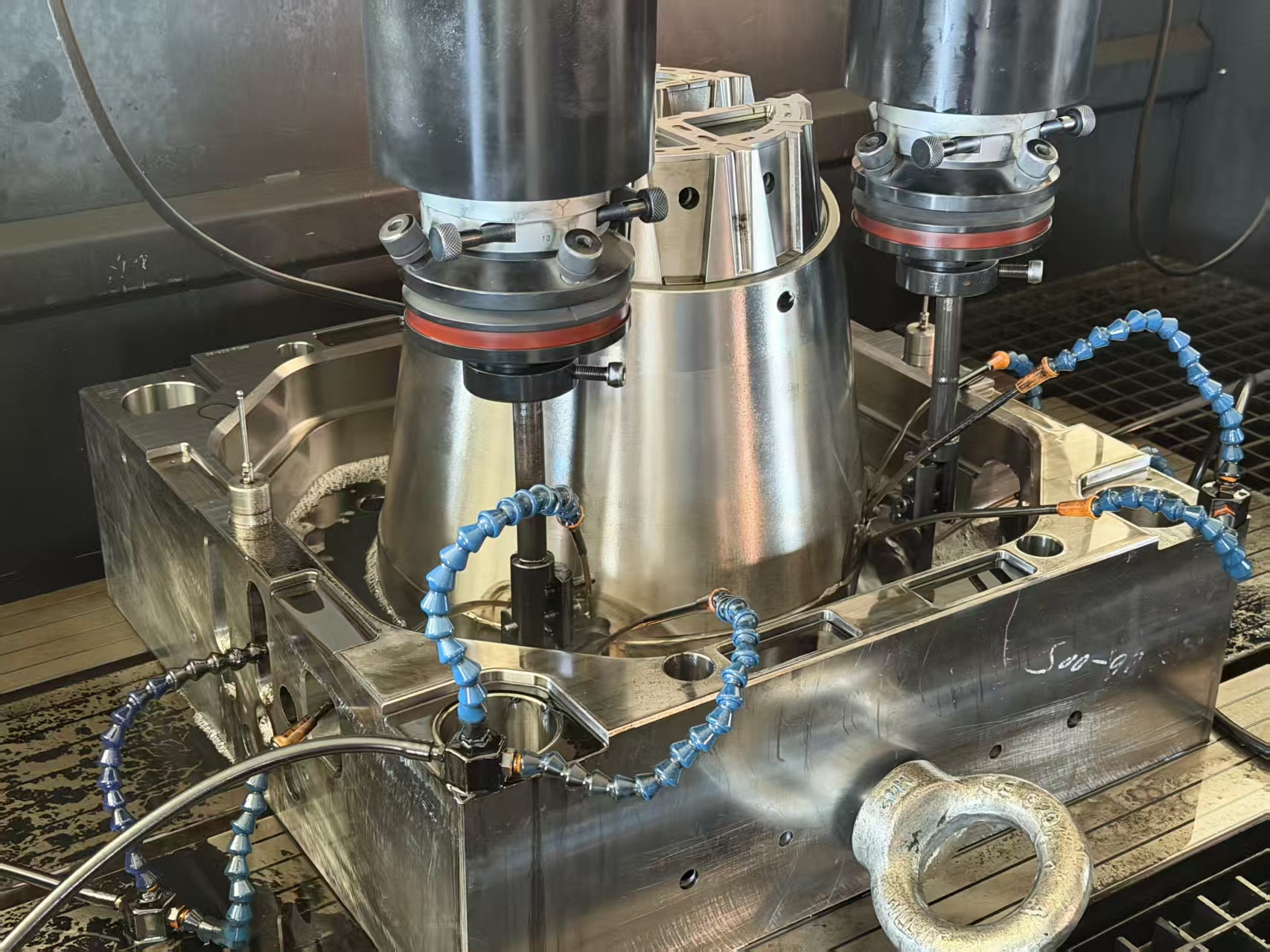
Close-up of a steel injection mold base being CNC milled, with vertical cutting spindles, blue directional coolant lines, and machined cavity pockets in progress.
Three Different Scopes Get Quoted as “Custom Injection Molding”
The word covers everything from a new masterbatch color to a 3D sculpted figurine tool with four slides. The commercial consequences are not comparable, so the first useful question to a supplier is which one they priced.
Rulyda runs tooling and presses under one roof — an in-house mold workshop alongside 85 injection machines up to 1,500 tons — which matters at T1 rather than at quotation. When the first sample needs a gate moved or a rib thinned, a tool shop inside the same building does not re-quote you for a supplier boundary.
Ask which scope a quote covers in writing. “Custom mold included” on a one-page quotation is the phrase that produces the scene at the top of this article.
The Four Numbers a Tool Quote Cannot Be Built Without
A tool price is not a function of the part’s drawing complexity in the abstract. It is a function of four inputs, and a supplier who quotes a custom injection molding project without them is estimating.
Two secondary inputs decide whether the quote is realistic rather than merely low: the surface finish on the A-surface (a textured cavity needs acid etching or an etched insert, and texture forces extra draft) and the decoration route (an IML pocket and vacuum ports are machined into the cavity before hardening, not added later).
Wall Section Is Set by Top Load, Not by Resin Price
Buyers who come from buying cartons often ask for the thinnest wall that holds the price. In custom injection molding for packaging the wall is a structural member and a thermal member, and it is usually the last thing that should be optimized.
Rulyda’s 5 gallon plastic bucket with lid is published at a 2 mm uniform wall with a 36 kg maximum load — a round PP pail designed for stacking and warehouse storage. The number that drove that 2 mm was not resin cost per part. It was stacking compression plus a drop requirement plus rim stiffness for a tear-strip lid.
Doubling the wall roughly quadruples cooling time, which is the largest single component of cycle time on a thick-section part. That is why the argument “make it 3 mm and be safe” costs more than it looks: it is paid on every part, in cycle time and in resin, for the life of the tool.
Draft, Shrink and Sink: The Geometry Arguments That Return at T1
Every one of the defects below is cheaper to fix on a screen than on hardened steel, which is why the DFM stage of a custom injection molding project carries more commercial risk than the quotation does. The question is not whether the molder can fix it, but which side of the contract the fix falls on.
The one document that prevents most of these arguments is the DFM report. Ask for it before the tool quote, and read these six items in it: draft angles per face, nominal wall and any variation, gate location and type, expected weld line and air-trap positions, ejection marks, and the predicted part weight. A DFM report that is only a marked-up screenshot is not a DFM report.
Decoration: Four Routes and Four Different Failure Modes
Decoration is where custom packaging is usually won or lost commercially, because it is the only part of the part the end customer actually inspects. Rulyda’s custom line supports IML, heat transfer, silk screen and pad printing, in matte or gloss — and the four are not interchangeable.
Two procurement notes follow from the table. First, the decoration route must be decided before the cavity is cut, because IML needs a pocket and vacuum ports and heat transfer needs a surface that the film can wrap without bridging. Second, ink and label systems are part of the food-contact file — a compliant resin with a non-compliant ink is a non-compliant article.
The Food-Contact File: Six Documents, Six Different Claims
This is the section buyers most often get wrong, and the one where an AI assistant answering a sourcing question will most likely quote a supplier page. The documents are not interchangeable and none of them is a certificate for your finished container.
For a North American retail or food-service program, the practical file is the 177.1520 resin statement, the masterbatch and ink compliance statements, and — where the buyer’s own specification demands it — a migration report on the finished article. For the EU, the DoC must be article-specific. Rulyda states FDA 21 CFR 177.1520 (resin), California Prop 65 and EU food-contact alignment on the custom product pages; buyers with a retailer technical file should request the article-level documents in writing rather than accept the resin statement as the whole answer.
What to Sign Off at First Article
T1 is not a beauty contest. It is the only moment in a custom injection molding program when tool corrections are still cheap, so the sign-off sheet should be measurable.
The A-surface map is the item most often missing, and it is the cheapest to add. It converts “acceptable appearance” from an argument into a drawing note.
Nesting Pitch and Carton Cube: Where Custom Containers Lose Freight Money
A tapered tub nests, and the nesting pitch — the added height per nested part — decides the carton cube and therefore the ocean freight per unit. The same taper that makes nesting work also makes the pail stack less stably when filled, and reduces the printable label area. It is a three-way trade, and the tool sets it permanently.
The reason nesting pitch needs to be a spec line rather than an afterthought: nested parts do not sit rim-to-rim. Anti-jam shoulders stop the parts wedging into each other so they can be separated in one motion at the filling line, and those shoulders add height per part. Work it through on a 40 mm pitch: 24 nested parts add 23 × 40 mm, or 920 mm, on top of the height of the first part — which is why tall tubs ship in double-stacked cartons rather than one column. Two numbers on the quotation close this question: nested pitch in millimeters, and carton cube per 100 pieces.
Tool Ownership, Tool Life and the Clause Buyers Forget
A tool is an asset with a finite life, and the quotation for a custom injection molding project usually does not say who owns it.
Four clauses belong in a custom tooling agreement, whatever the steel: a tool ownership certificate in the buyer’s name; a stated shot life with the basis for it; a tool maintenance and repair responsibility split; and a tool transfer clause with the 2D tool drawing, the T1/T2 reports and the process sheet handed over on request. A supplier that will not put tool ownership in writing is telling you something about the next quotation.
Rulyda publishes a 10–30 day product development cycle for custom work, supported by an in-house tool workshop and an in-house laboratory for drop, load and material analysis. Ask for the T1 date in that schedule, not a single headline lead time, because the number that matters to a retail launch is the date of the sample you can test.
FAQ
Q: Can you mold from an STL file only? A: An STL carries geometry but no tolerances, no datum scheme and no units annotation. It is enough to quote a rough tool, not enough to cut one. For anything with a lid interface, a pallet interface or a filling-line fit, send STEP with a 2D sheet for the critical dimensions.
Q: How long does a new tool take from a STEP file? A: For a single-cavity packaging tub, the tool build plus T1 usually sits inside the product development window a supplier publishes — at Rulyda that window is 10–30 days. Multi-slide tools, 3D figurine shells and IML pockets with vacuum ports run longer. Ask for the T1 date and the T2 date separately, because the gap between them is where optimism lives.
Q: Is IML more expensive than heat transfer? A: Per label, usually yes; per sellable unit it depends on your scrap rate and run length. IML wins on long runs and on products that get washed or abraded; heat transfer wins on short seasonal runs with full-wrap artwork. If your product is a solvent, the ink system decides the question, not the unit price.
Q: Do I need a new tool to change the color of a bucket? A: No. Color is a masterbatch decision and the tool is untouched. What does change is the tolerance conversation: a Pantone match on an opaque color is routine, on a translucent or clear part the molder needs an approved physical standard, because light transmission is not on the Pantone chip.
Q: Who owns the mold we paid for? A: Whoever the contract says. Pay for a tool and leave ownership unstated, and you have bought capacity, not an asset. Get a tool ownership certificate with the serial number of the tool, and check that the drawing set transfers with it.
Q: Does an FDA 21 CFR 177.1520 statement mean my container is FDA approved? A: No. 177.1520 permits certain olefin polymers for food-contact use; it does not certify a finished article, and FDA does not issue approvals for containers. What you hold is a resin compliance statement plus, if your buyer requires it, a migration test report on the finished part. Wording matters here — a supplier that writes “FDA certified bucket” is describing the resin, not the tub.
Q: Can you match a competitor’s container exactly? A: Dimensionally, usually yes — that is reverse engineering from a sample or a scan. Where it stops is protected design: registered designs, 3D shape marks and patented features. Send the sample and say what must match functionally, and let the tool shop tell you which features it can reproduce freely.
Related Products
- Custom Popcorn Bucket — fluted PP tub with anti-jam nesting shoulders, IML or heat transfer, Pantone-matched.
- Custom 3D Figurine Popcorn Bucket — sculpted character containers tooled from your 3D or 2D concept, for cinema and theme-park programs.
- Custom Plastic Paint Mixing Cups — solvent-resistant printed ratio scales, translucent PP/ABS, tooled from CAD.
- Custom Food Grade Plastic Box — snap-fit food container with a contoured shell and repeatable reseal.
Talk to the Tooling Team Before You Cut Steel
Send the STEP file with the application, the annual volume and your food-contact market. If the custom injection molding brief is still a sketch, send the sketch. Rulyda’s engineering team reviews draft, wall section, gate position and decoration route, and returns a DFM note with the tool quotation rather than after it — from an ISO 9001 factory in Qingdao with an in-house mold workshop and 85 presses up to 1,500 tons.












 2026/11/05