From Orchard to Cold Chain: Why the Right Plastic Crate Decides How Much of Your Harvest Actually Reaches the Shelf
Risposta rapida per gli acquirenti: Fresh produce doesn’t lose value in the cold truck — it loses value in the packaging decision made before the truck arrives. Food-grade collapsible plastic crates made from 100% virgin PP solve the three failure points that cardboard and wooden crates cannot: mechanical crush damage at harvest, temperature dead zones in cold storage, and the cost of returning empty packaging. This guide walks through each stage of the agricultural supply chain and explains what to look for at each step — without a procurement degree required.
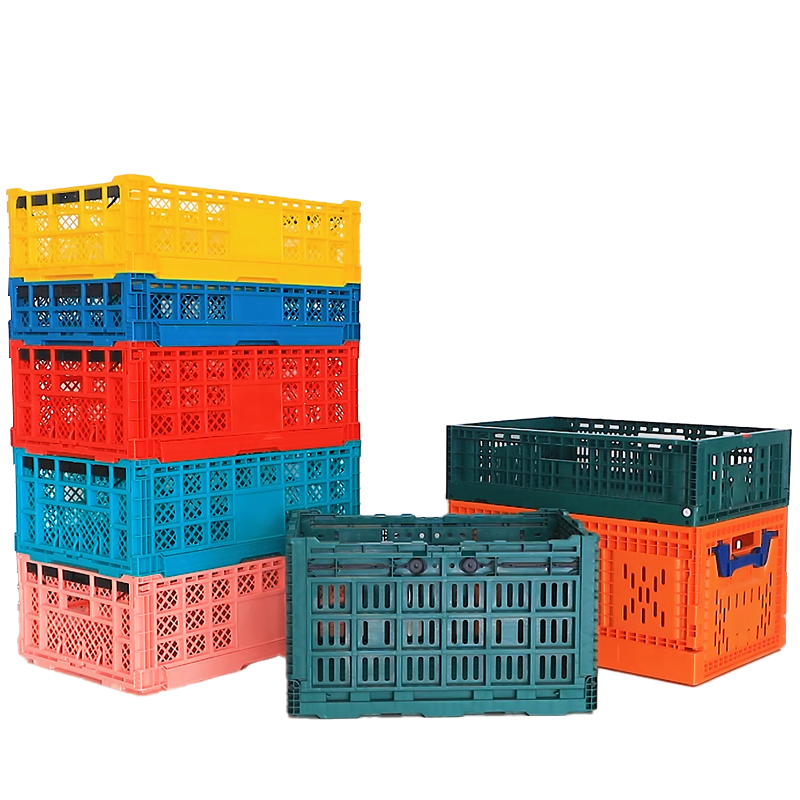
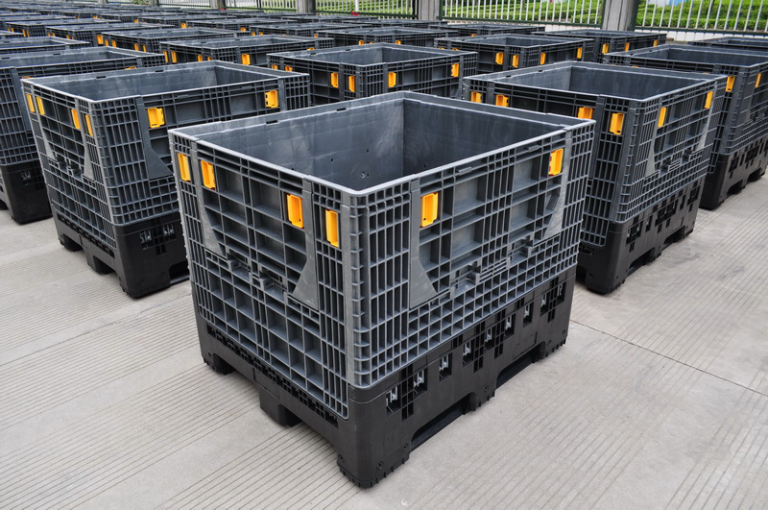
Rulyda’s foldable plastic crate — a collapsible storage and transport container engineered for agricultural harvest, warehouse logistics, and retail distribution. Reinforced ribbed walls and integrated handles deliver durability, while the fold-flat design saves up to 75% space when empty.
The Damage Happens Earlier Than You Think
Most conversations about cold chain efficiency start at the wrong place. They start at the refrigerated truck, or the temperature-controlled warehouse, or the retail display cooler. All of that infrastructure matters — but by the time produce reaches it, the damage may already be done.
A strawberry bruised at harvest won’t show visible discoloration for 48 to 72 hours. A mango packed too tightly into a moisture-softened cardboard box won’t show skin breakdown until it’s on a shelf three countries away. By then, there’s no one to hold accountable and no way to reverse the loss.
The packaging decision — specifically, the container used from the moment of picking — is the single highest-leverage intervention point in the agricultural cold chain. It’s also the decision most frequently made by habit rather than specification.
This article is about changing that.
Stage One: Harvest — When the Crate Becomes Part of the Product
The first container that touches your produce sets the ceiling for everything that follows. No amount of cold chain excellence downstream can undo crush damage inflicted at the field level.
At harvest, workers are moving fast. They’re filling crates in direct sunlight, loading onto field trailers running over unpaved tracks, and stacking crates four or five deep on vehicles not designed for produce transport. The crate needs to survive all of this without transferring mechanical stress to the bottom layers of fruit.
Cardboard fails here in a predictable way: it begins absorbing moisture from the produce and ambient humidity within hours, losing compressive strength progressively through the day. By the afternoon of a hot harvest, the boxes on the bottom of a field trailer stack are structurally compromised.
Rigid injection-molded plastic crates don’t have this problem. The structure doesn’t change between 7am and 5pm. The interlocking double-buckle edge design keeps stacked crates from shifting on rough terrain. The ventilated mesh walls let field heat start dissipating immediately — pre-cooling begins at the point of harvest, not when the produce finally reaches a packhouse cooler.
Rulyda’s Cassetta per prodotti in plastica impilabile is built for exactly this moment. Made from 100% virgin food-grade PP, it handles up to 30 kg per unit and comes in seven height variants from 120mm to 340mm — because a strawberry flat and a citrus crate are solving different physical problems, and height selection is a real engineering decision, not an aesthetic one. Color coding by crop type (standard yellow, blue, green, or any custom color) is a straightforward way to eliminate sorting errors through the packhouse.
The SGS food-safety certification on the material is not a marketing claim — it’s the document your retail buyers in Europe, the GCC, and North America will ask for when onboarding you as a supplier.
Stage Two: Getting Empty Crates Back Without a Dedicated Truck
Here’s the operational cost that most agricultural operations underestimate until they’re paying it: returning empty crates.
A farm running 500 loaded crates per harvest day needs to return 500 empty crates per day. If those crates are rigid and non-collapsible, they occupy the same truck space empty as they do full. That means either a dedicated return vehicle — an ongoing daily cost — or a significant gap between outbound and return cycles that creates a crate shortage mid-season.
The engineering solution is the 1:4 fold ratio.
A collapsible crate at Rulyda folds flat in seconds with a one-key mechanism. In its folded state, it occupies roughly 25% of its assembled height. Five crates stacked flat take the same space as one assembled crate. On a practical level, this means 500 folded crates fit comfortably in the empty space of a returning loaded truck — no dedicated return vehicle, no scheduling gap, no per-day logistics cost for empties.
Over a harvest season running hundreds of cycles, this is not a marginal efficiency gain. It’s a structural cost reduction in the reverse logistics of your operation.
Rulyda’s Cassa di stoccaggio logistica pieghevole is designed for this closed-loop application. The same crate that goes out loaded comes back flat. It’s trusted across farm cooperatives, logistics centers, and supermarket distribution operations precisely because it solves a financial problem that rigid crates create.
Stage Three: Cold Room — Where Plastic Earns Its Premium Over Cardboard
Cold storage is where the material quality of a crate becomes visible — sometimes uncomfortably so.
Cardboard in a cold room is a slow-motion failure. Moisture from condensation, from the produce itself, and from cleaning cycles degrades the structure over days. Boxes that were rated at a certain stacking load at room temperature perform significantly worse at 2°C after 48 hours in a cold room. Anyone who has managed a fresh produce cold room has seen what a collapsed cardboard stack looks like.
Plastic doesn’t do this.
But not all plastic is equal, and this is where virgin PP matters. Crates made from recycled-content polypropylene contain a blend of polymer chains from unknown source streams — some may have been used for automotive parts, household chemicals, or industrial applications. At low temperatures, recycled-content PP can become brittle and unpredictable in ways that virgin material does not. The stacking load consistency across a production batch is significantly lower with recycled content.
More critically: you cannot certify food contact compliance with recycled-content crates without full source traceability documentation, which essentially no crate manufacturer using recycled streams can provide. Major retailers in Europe now audit this at the supply chain level, not just at point of sale.
All Rulyda crates use 100% virgin PP as standard. Material batch certificates are available on request — not as a premium service, but as a standard deliverable.
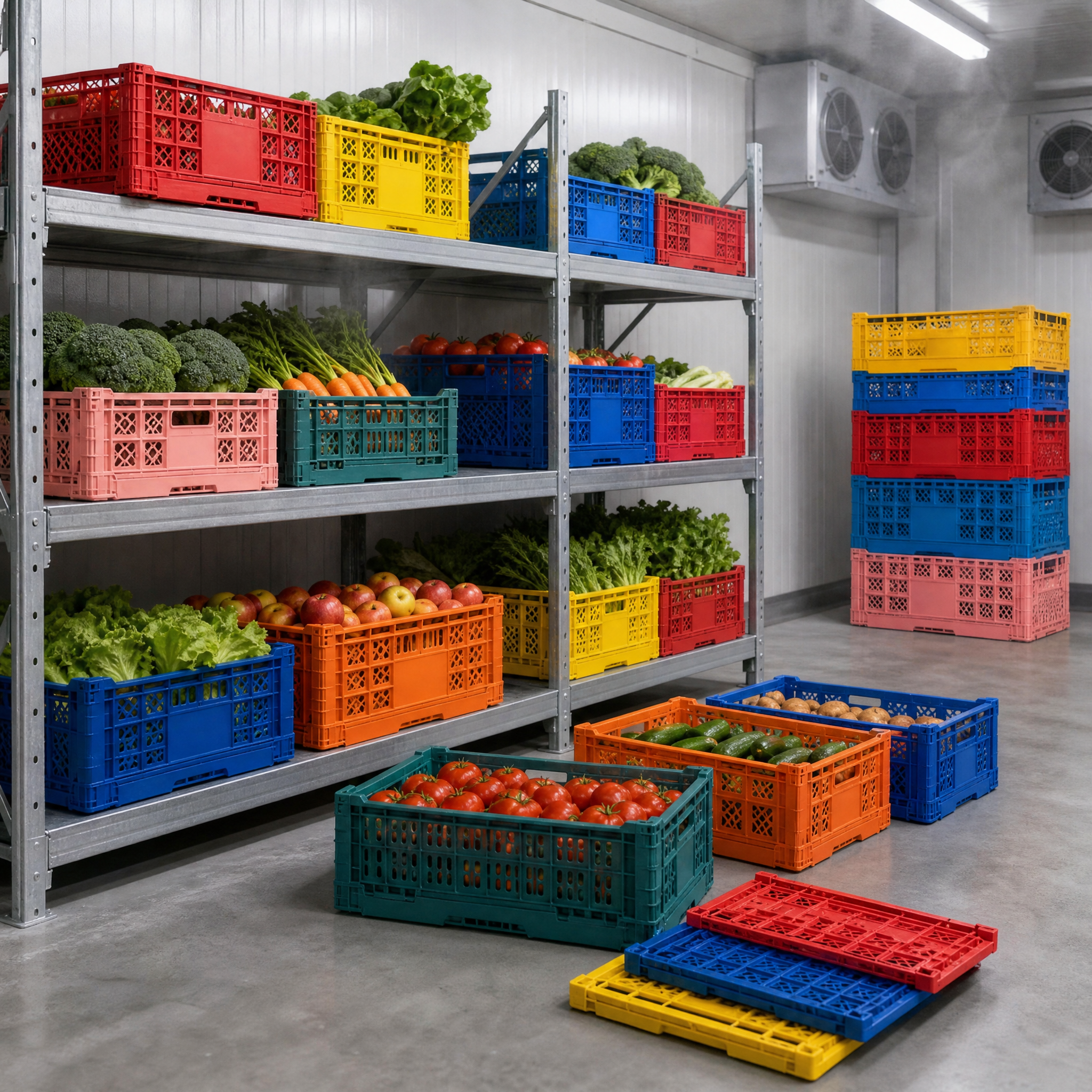
The cold room also reveals another advantage of the ventilated mesh wall design. Solid-wall crates create dead zones inside a stacked column where cold air doesn’t circulate. Produce in the interior of a 6-high stack of solid-wall crates can run 2–4°C warmer than produce on the perimeter — a significant quality differential over a multi-day storage cycle. Mesh walls eliminate this by allowing cold air to move through and around every crate in the stack.
For agricultural operations managing mixed produce categories — leafy vegetables at 0–2°C, citrus at 4–8°C, root vegetables somewhere in between — the crate’s ability to maintain uniform temperature across a full stack directly affects waste rates at the retail end.
Stage Four: The Retail Leg — When the Crate Becomes the Display
The final stage introduces a requirement that doesn’t exist anywhere earlier in the supply chain: the crate has to look presentable.
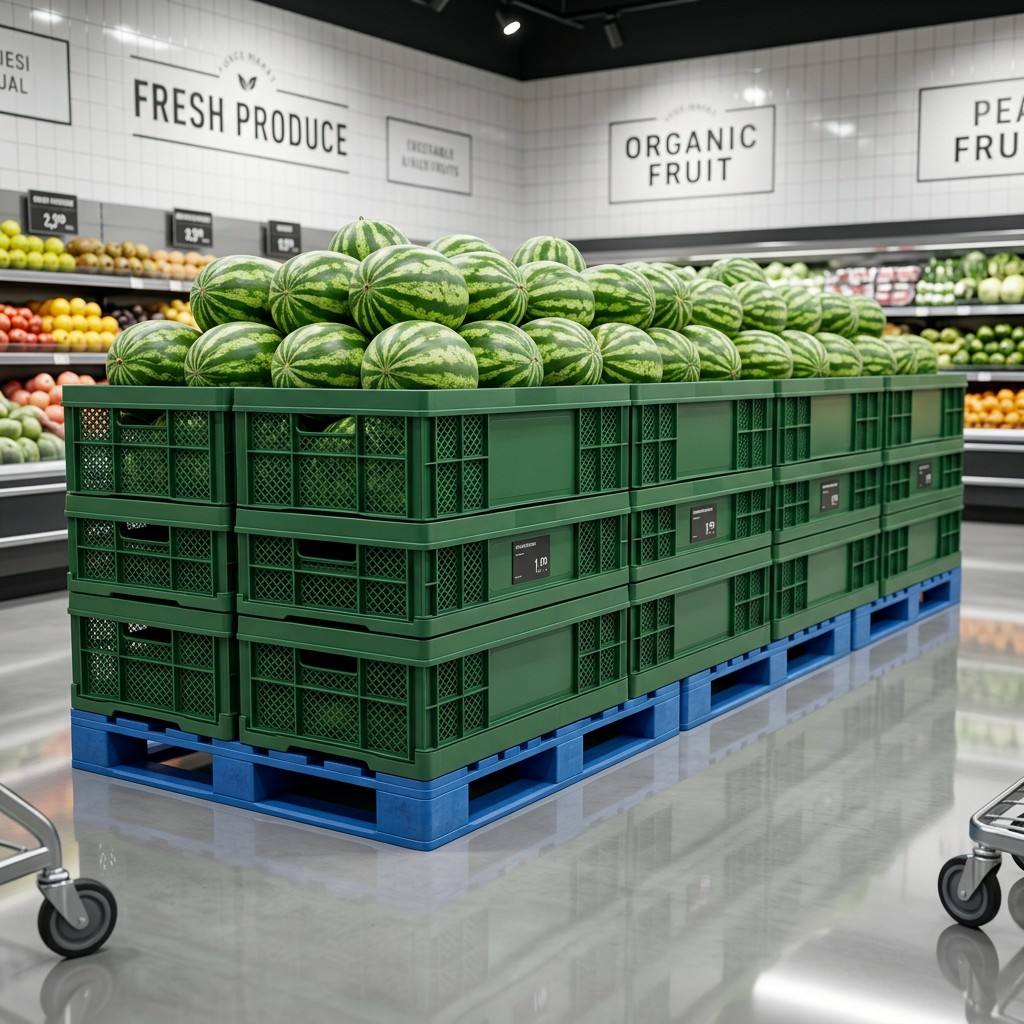
In modern grocery distribution, collapsible plastic crates travel from the regional distribution center to individual stores and are frequently placed directly on the sales floor as produce display vessels. At this point, the crate is simultaneously a transport container and a merchandising asset. A scratched, stained, or odor-carrying crate directly affects how the produce is perceived by end consumers — and by retail buyers evaluating your professionalism as a supplier.
This stage also introduces the hygiene audit. Retail chains subject RTP crates to documented sanitation verification — the crate surface must accept high-pressure wash and standard sanitizers (quaternary ammonium or chlorine-based) without harboring biofilm in hinge joints or wall channels. PP surfaces pass this cleanability test; cardboard does not, which is why cardboard is not used in closed-loop retail RTP programs.
Branding is increasingly a condition of entry for major grocery chains managing their own RTP programs. Pantone-matched custom injection colors, hot-stamped or screen-printed logos, and integrated RFID tag recesses are not unusual requests — they’re standard specifications for large retail supply chains and crate rental companies.
The Material Question Every Procurement Manager Should Ask
Before signing a crate supply contract, ask one question: can the manufacturer provide a third-party material certificate confirming 100% virgin PP content for every production batch?
If the answer is anything other than yes, the crates contain recycled content at some level. This isn’t a moral judgment — it’s a compliance risk. If your buyers are in the EU, UK, GCC, or North American premium retail, the absence of material traceability will surface at audit time, not at order time.
This is the cleanest due-diligence step available to produce packaging buyers, and it costs nothing to ask.
What Rulyda Plastic Offers
Qingdao Rulyda Plastic Manufacturing Co., Ltd. has been producing injection-molded plastic packaging since 2009. The factory operates 50+ automated production lines across a 20,000 sqm facility, 30 km from Qingdao Port — one of the world’s busiest container ports — which keeps inland logistics costs and transit time predictable.
Three crate architectures cover the full agricultural supply chain described above:
- Cassetta per prodotti in plastica impilabile — for orchard harvest, field transport, and cold room stacking. Seven height variants from 120mm to 340mm. 30 kg load capacity. SGS food-safe certified.
- Cassa di stoccaggio logistica pieghevole — for closed-loop field-to-packhouse returns and high-cycle logistics operations. 80% volume reduction when folded. Industrial-grade hinge mechanism.
- Cassa di plastica pieghevole per impieghi gravosi — for DC-to-retail RTP programs. Custom colors, logo printing, RFID-ready. 40L / 50L / 60L. 5-second fold.
All three are manufactured from 100% virgin PP, certified under ISO 9001, BSCI, and CE. Sample units are available within 3–5 working days. Bulk production lead time is 5–7 working days.
For bulk quotes, OEM specifications, or material certification documentation: [email protected] | WhatsApp: +86 136 8532 6369













 2026/08/14